















How Do Real Time Payments Work?
Real time payments enable funds to move between bank accounts instantaneously and continuously, 24/7. Unlike traditional ACH or wire transfers that take hours, these networks settle transactions in seconds.
Merchant accounts, acquiring routes, and chargeback controls, matched to your risk profile.

The demand for swift and efficient transactions is driving the evolution of payment systems as we know it. Real time payments are a significant leap forward, enabling funds to be transferred instantly and continuously - 24/7, 365.
Unlike traditional payment systems, a few examples being ACH and wire transfers, which can be sluggish and take hours, real time payments ensure that funds move from one account to another, instantaneously.
Understanding how a real time payments network operates - from initiation and authentication to processing and settlement - reveals the underlying technology that makes real time transactions possible.
This blog dives into the intricacies of real time payments, exploring their advantages and challenges, as well as the infrastructure that supports this payments innovation.
What are Real Time Payments?
Real time payments are electronic payments that occur instantaneously and continuously. This can occur within seconds of the transaction being initiated, at which the funds immediately become available in the payee's bank account.
Unlike traditional payment methods (like ACH and wire transfers), which can take hours or even days to complete transactions, real time transactions are settled immediately from one bank account to another.
An instant payment can be made any time of the day or week, holidays and weekends included.
Examples of Real Time Payments
Real time payments are most commonly used in the world of eCommerce, but they have their uses in other industry verticals.
Instant payments are often seen in bill payments, tax rebates, unemployment benefits and peer-to-peer payment platforms.
Open Banking and Request to Pay Rails
For UK merchants, real-time payment implementation relies heavily on Open Banking APIs and Request to Pay (RtP) messaging protocols. Rather than passing through legacy card schemes, funds move directly between bank accounts using ISO 20022 XML data standards. This direct ledger transfer provides immediate payment finality.
- Irrevocability: Real-time transfers carry irrevocable settlement, eliminating classic chargeback risks and friendly fraud associated with card processing.
- Execution timing: Transactions execute within 15 seconds, whereas standard BACS payments require three working days for clearance.
- Fee structures: Direct account transfers bypass interchange costs, replacing variable percentage fees with a flat fee per transaction.
How Do Real Time Payment Systems Work?
Real time payment networks differ across the world. Each system has its own unique characteristics, but at the core payments infrastructure involves the same actors and operations within the payments infrastructure.
Actors Involved in the Real Time Payments System
The actors involved in the real time payment transactions are:
- The payer: The person or business initiating the payment.
- The payee: The person or business receiving the payment.
- The payer's bank: The financial institution of the payer.
- The payee's bank: The financial institution of the payee.
- The real-time payment network: Such as the RTP (Real-Time Payments) network or similar systems (like the Faster Payments Service in the UK), which facilitate the transfer of funds and communication between banks.
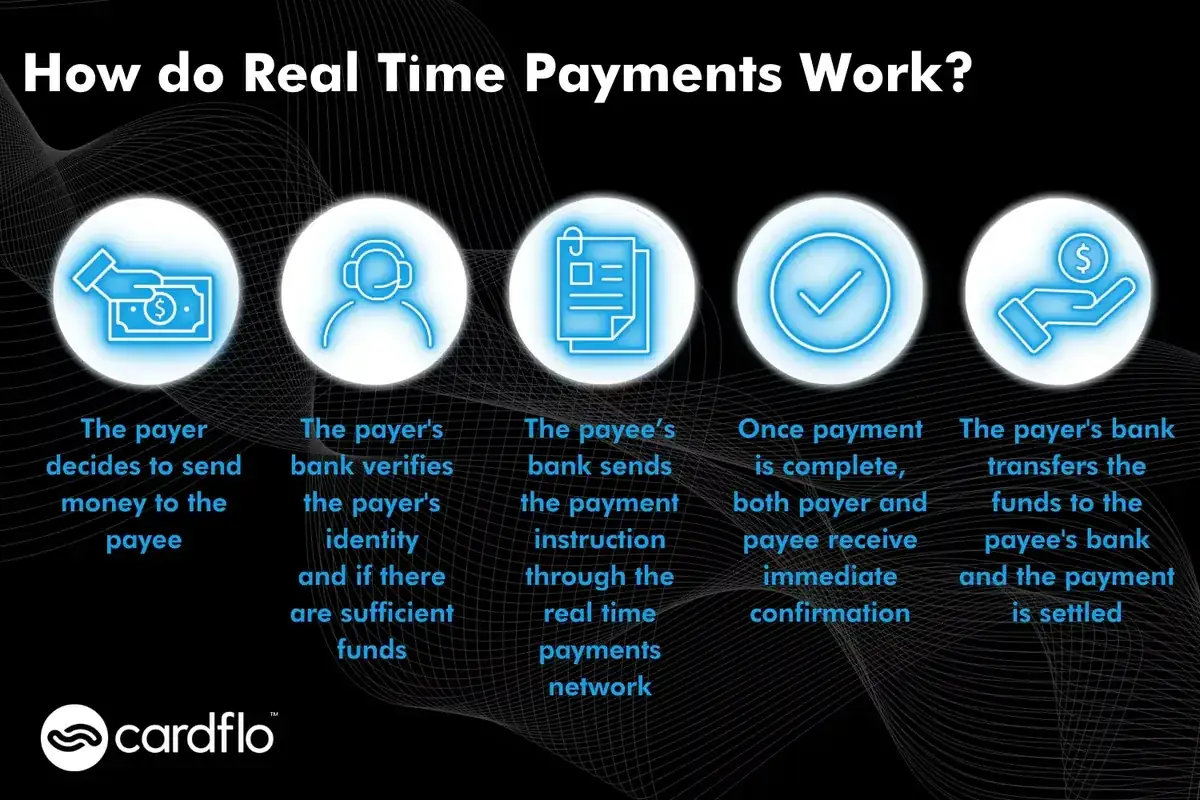
Steps Involved in the Real Time Payments System
1. Initiation
The real time payments process is initiated when the payer decides to send money to the payee. This can be done through online banking platforms, mobile bank apps, in branch, or through other payment systems.
When transferring funds, the payer can use traditional payment methods such as account numbers or modern methods such as a QR code.
Financial transactions can be made across multiple channels, making them flexible and adaptable to differing needs.
2. Authentication & Authorisation
Following payment initiation, the payment must be authenticated and authorised. The payer's financial institution confirms the payer's identity through security measures such as passwords, biometric data and two-factor authentication.
The payer's bank verifies whether sufficient funds are available to conduct the transaction. Once authorised, the payments platform authorises the transaction, immediately deducting funds from the payer's account.
3. Processing
Once it has been authorised, the bank instructs the real time payment networks to complete the transaction.
A real time payments platform is a central network operated by a financial authority or group of banks.
Unlike legacy payment systems, real time payments do not use batching. They continuously process individual transactions, allowing for instant payments in real time.
4. Confirmation
After the payment is processed, both the payer and payee are immediately notified about the transaction - this can be done via SMS, email, or a push notification via a mobile banking app.
Risk management strategies, like notifications, provide businesses with certainty regarding their transactions and finances.
5. Settlement
Here, the payer's bank transfers the funds to the payee's financial institution instantaneously - making the funds available for immediate use in the payee's account.
Are Real Time Payments & Faster Payments the Same?
Real time payments are not the same as faster payments. Though similar in nature, ironically, faster payments take longer to complete. Usually, faster payments take somewhere between a few minutes to a few hours, which is shorter than most traditional payment systems, but longer than real time payments.
Real time payments are immediate payments in the sense that there is no interval between the moment when the funds are deducted from the payer’s account and the moment when the funds are made available to the payee‘s account.
Key Technical Distinctions
In the UK, the Faster Payments Service (FPS) operates on a Deferred Net Settlement (DNS) model, where central bank settlement between participating institutions occurs in designated cycles throughout the day, even though end-user account ledgers update within seconds. In contrast, pure real-time payment rails utilise Real-Time Gross Settlement (RTGS), settling each transaction individually at the central bank level instantly.
For merchants, this distinction impacts transaction limits and operational costs:
- Transaction Limits: Whilst the UK FPS scheme sets a structural limit of £1,000,000 per transaction, individual commercial banks frequently impose lower caps (often £25,000 to £50,000 for corporate online banking).
- Data Standards: Modern RTP networks leverage ISO 20022 messaging formats, allowing rich remittance data to travel alongside the payment, unlike legacy FPS message structures.
- Cost Structure: FPS transactions typically cost merchants between 1p and 5p per transaction when initiated via Open Banking APIs, significantly lower than standard card acquisition fees.
The Advantages of Real Time Payments
Speed & Efficiency
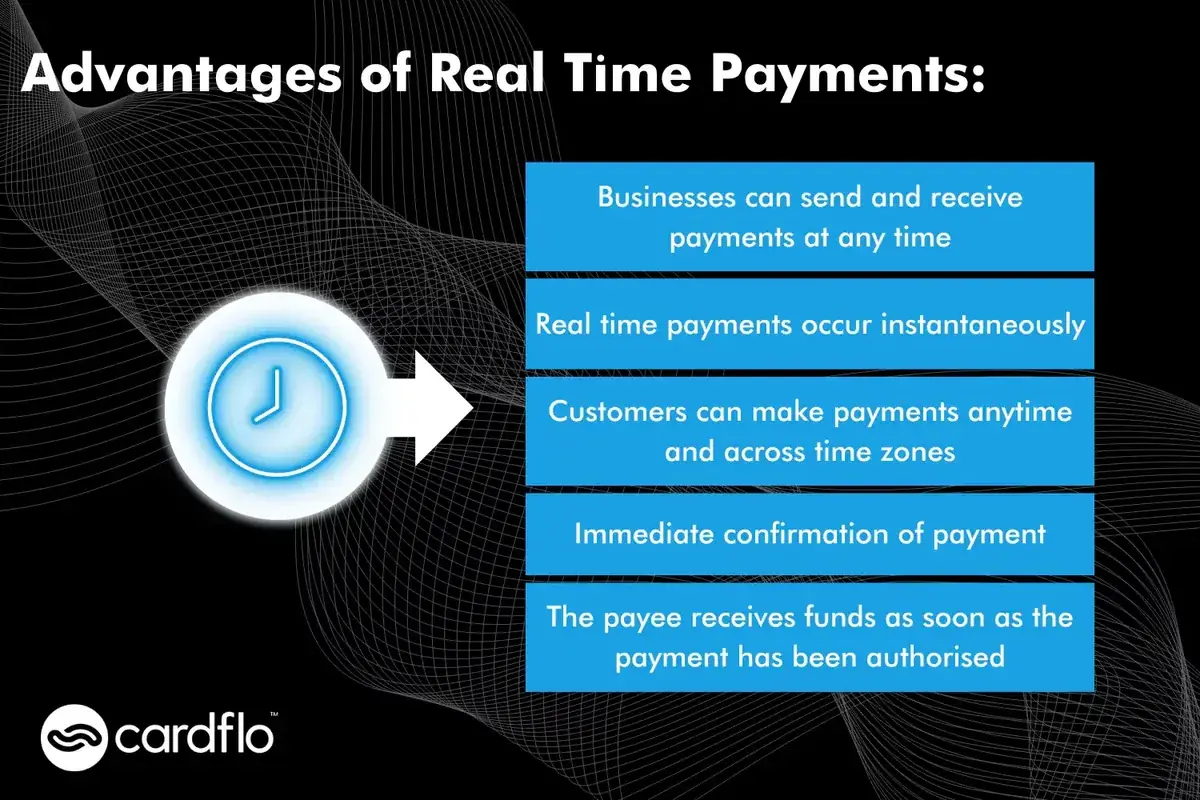
Unlike traditional payment systems, real time payments are an immediate payment service. Funds are transferred instantly and can be made 24/7, allowing businesses to send digital payments at any given time.
They work across multiple channels, making it highly flexible and adaptable to facilitate real time payments in a business to consumer setting.
This is particularly useful for global businesses, which have customers in different time zones, operating around the clock.
Cash Flow
Real time payments facilitate cash flow management as the payee receives funds as soon as the payment has been authorised.
The payee can then choose to spend those funds how they see fit, whether that be to make supplier payments, pay bills, or loan repayments.
Transaction Certainty
Real time payments provide immediate confirmation of payment. This assures the payer and the payee that the transaction has been successfully completed.
This is particularly important for industries where the instant transfer of funds can expedite the entire process, such as real estate.
Customer Experience
Real time payments provide customers with the possibility to make payments anytime and anywhere.
The convenience can significantly improve the overall experience and particularly when customers would like to get immediate access to the product they purchase.
Commercial and Operational Savings
Beyond speed, real-time push payments offer merchants significant cost reductions compared to traditional card acquiring rails:
- Reduced Processing Overhead: Account-to-account transfers via Open Banking bypass card scheme interchange fees (often 1.5% to 2.5% per consumer credit card transaction), replacing them with flat fees typically between 1p and 5p.
- Elimination of Chargeback Fraud: Because transactions are customer-authenticated push payments using Strong Customer Authentication (SCA), they are final and non-reversible via card scheme dispute mechanisms, avoiding standard dispute fees of £15 to £25 per incident.
- Working Capital Optimisation: Bypassing the standard T+2 or T+3 card settlement lag frees up operational liquidity, enabling merchants to negotiate early-payment discounts with trade suppliers.
The Disadvantages of Real Time Payments
Payment Fraud & Security Risks
The most significant disadvantage of real time payments is the increased risk of fraud.
As payees automatically receive payments, a real time payment leaves very little time for fraud management procedures. This is could potentially lead to significant losses as the transaction is almost irreversible.
This makes its vital than ever to integrate fraud detection and protection technologies to make it a more secure system.
Costs
The implementation of real time payments can be a complex and costly procedure, which requires investments in differing banking infrastructure.
Businesses and financial institutions alike need to regularly update their payment systems in order to efficiently handle these transactions. This can be done through the implementation of modern APIs and enhanced security measures.
Regulatory Challenges
Real time payments can be subject to different regulatory systems, depending on the region where the payment is processed and where the payee is located.
Businesses and financial institutions need to ensure that they are fully compliant with all relevant laws and regulations. This can be particularly challenging for those operating in multiple jurisdictions, as they may need to comply with a variety of different regulations.
Real time payments are subject to different regulatory requirements, depending on the region that the payment is processed and where the payee is located.
Why your business needs real time payments
Real time payments provide for instantaneous, 24/7 fund transfers - contrasting with the cumbersome processes associated with traditional payment methods like ACH payments and wire transfers.
This system supports various applications, from eCommerce to bill payments, offering an unmatched speed and flexibility.
However, the shift to real time payments does come with its challenges, including the heightened risk of fraud and the need for robust security measures, as well as great implementation costs and regulatory obstacles.
Businesses, consumers, and financial institutions must navigate these complexities in order to leverage the full benefits of real time payments.
Adopting real-time payment rails significantly optimises working capital management for merchants. By settling transactions in under ten seconds via ISO 20022 messaging standards, businesses eliminate the need for rolling reserves or pre-funding arrangements often required by acquiring banks.
Financial and Operational Benefits
- Lower processing overheads: Account-to-account (A2A) real-time transfers bypass traditional card scheme rails. This removes percentage-based ad valorem interchange fees, substituting them with fixed, flat pence-per-transaction charges (often between 5p and 20p).
- Irrevocable settlement: Real-time rails provide immediate finality of settlement. Unlike card payments, which remain vulnerable to chargebacks for up to 120 days, completed real-time transfers cannot be unilaterally reversed by the payer.
- Automated reconciliation: Enhanced data payloads enabled by ISO 20022 allow platforms like Cardflo to automatically match incoming funds with specific invoice numbers, drastically cutting manual back-office administration.
Related reading
A merchant acquirer is a licensed bank that holds your account, takes liability for transactions, and settles funds. The payment processor is the technology layer routing data between the checkout, card networks, and issuing banks. Every card payment requires both components to manage technical encryption and financial liability. They are often separate entities with distinct fee structures.
A merchant acquirer is a financial institution that processes card transactions and verifies funds. The payment gateway acts as the technological bridge, encrypting sensitive data between the website and the acquirer. Merchants need both components to ensure that electronic payments are accepted, authorised, and settled. Together, they create a seamless and secure payment experience for customers.
A merchant account is a specialised business account used to accept electronic payments like Apple Pay and Google Pay. It acts as a bridge between the business and the customer bank. Funds are held here for verification and compliance before being transferred to a main bank account. This process ensures that all transactions are secure and reduces the risk of fraud for the merchant and the customer.