















How to Add Recurring Payments on Your Website: A Step-by-Step Guide
Adding recurring payments to your website can enhance customer convenience and generate steady cash flow. By choosing the right payment gateway, businesses can securely automate subscription billing for memberships or physical goods.
Merchant accounts, acquiring routes, and chargeback controls, matched to your risk profile.

To add recurring payments on a website, a merchant needs a payment provider that supports stored credentials, subscription consent, retry rules and secure card tokenisation. The setup should capture clear billing terms at checkout, schedule repeat charges and give customers a simple way to update or cancel their payment details.
Whether you offer subscription boxes or a membership service, recurring payments can help accept payments, streamline transactions and boost customer retention.
The subscription economy has grown by a staggering 435% over the last decade and is projected to reach a market size of $1.5 trillion by 2025, reinforcing the ever-growing need to set up recurring payments on your online stores.
This article will walk you through how to add recurring payments on your website so you can start accepting recurring payments online efficiently.
Selecting a recurring payment gateway
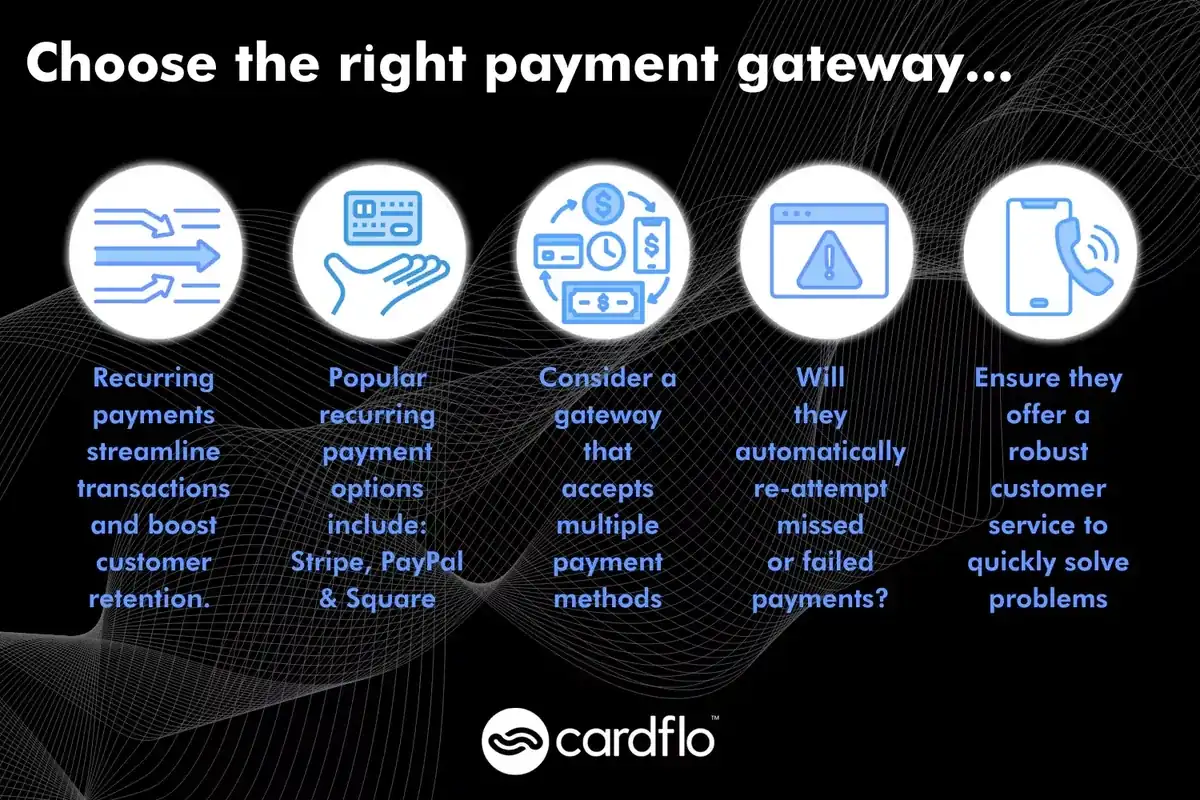
Before you can effectively accept recurring payments online, you must choose the right payment gateway for your business.
Payment processing is essential for accepting payments online, ensuring that customers can securely provide their payment details to set up automatic recurring payments.
Popular recurring payment options like Stripe, PayPal and Square allow businesses to accept credit or debit card payment, as well as other payment methods, on a recurring basis.
Selecting the right payment gateway that offers a recurring payment option ensures that the entire process is smooth and helps reduce failed transactions.
It is also important to consider a payment gateway that accepts multiple payment methods, re-attempts missed or failed payments and offer robust customer service.
Set Up an Account and Configure Recurring Payment Options
Once you've selected your payment gateway, you might need to set up a merchant account with a merchant account provider.
During the set up process, you'll need to configure your recurring payment options, including billing intervals (e.g., monthly or yearly), trial periods and exclusive offers such as free trials.
For businesses using a WordPress site, plugins like WP Simple Pay make it easy to activate and configure recurring billing all from the WordPress Admin Dashboard.
The SetUp Wizard guides you through the recurring payment configuration form as well as other additional features, such as pricing tiers and flexible billing periods, ensuring that the tailored recurring fee structure meets your customers' needs.
However, it is possible to accept recurring payments without a SetUp Wizard and WP Simple Pay. Recurring payments can be accepted with only a payment processor, so long as you have a self-built billing engine on your end or utilise the basic billing engines provided by popular payment gateways.
Integrate the Payment Gateway with Your Website
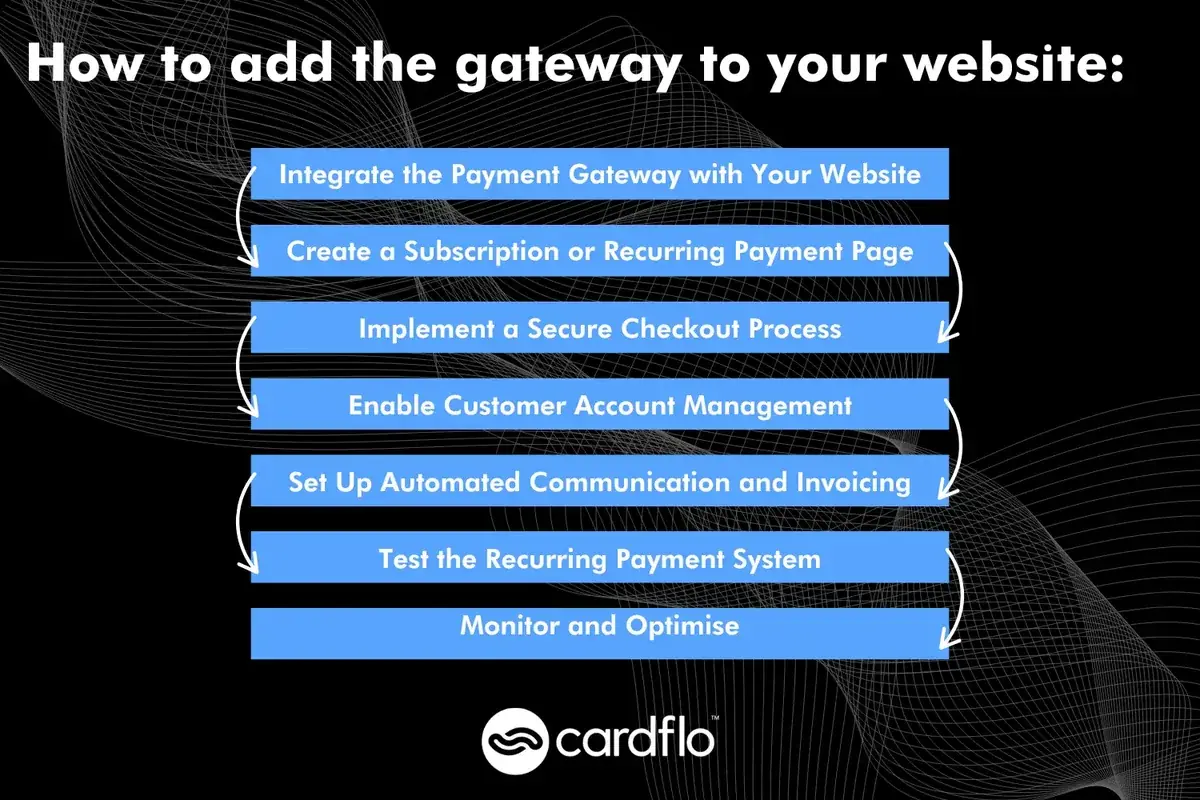
The next step in accepting recurring payments is integrating your chosen payment gateway into your site.
For businesses using WordPress Admin Dashboard, tools like WP Simple Pay make it easier to embed payment methods that facilitate recurring payments.
Whether you have online stores or offer online courses, the integration process relies on ensuring that payment information can be securely process each time a customer's chosen payment method is regularly charged.
Most reputable payment gateways offer developer-friendly APIs for custom-built websites, ensuring that recurring payment system functions smoothly without any interruptions.
Technical Webhook Setup and Security
When integrating via REST APIs, robust webhook handling is mandatory for managing asynchronous subscription events. Your server must receive alerts for payment failures, renewal confirmations, and card updates, returning an HTTP 200 response within 2,000 milliseconds to avoid triggering aggressive retry routines.
- Security standards: Integration endpoints must enforce TLS 1.3 encryption and validate webhook signature headers using HMAC secret keys.
- Sandbox simulation: Use simulated test clock features from payment providers like Cardflo to advance time during staging. This allows developers to test annual billing renewals, retry schedules, and mid-cycle cancellations instantly.
Leveraging official gateway SDKs simplifies this process by automating payload deserialisation and network retry logic.
Create a Subscription or Recurring Payment Page
Subscription services are becoming increasingly popular, with 81% of consumers using subscriptions due to the convenience that they offer.
Creating a dedicated subscription service page on your website, that includes a recurring payment form, is essential to begin accepting payments.
This webpage must clearly outline your subscription pricing tiers, recurring donations (if applicable), utility providers and the benefits that regular payments provide your customers.
Businesses that offer subscription boxes, membership services, or are utility providers can boost their conversions by detailing how customers can benefit and save time through automatic recurring payments.
By clearly displaying the terms of subscription payments, such as the billing period and retry policies for missed payments, can help to further build trust with your customers.
Implement a Secure Checkout Process
The recurring billing payment process must be secure in order to encourage customers to complete their transactions.
Ensure that your payment system uses SSL encryption and is compliant with PCI DSS standards to protect customers confidential payment details.
Many payment gateways also offer fraud protection tools, ensuring customers’ credit card payments are processed safely.
A secure checkout process will help your business easily accept recurring payments while building customer loyalty.
SCA and Tokenisation Mechanics
Under UK PSD2 regulations, recurring billing relies on Strong Customer Authentication (SCA) during setup. The initial purchase is classified as a Customer Initiated Transaction (CIT), requiring 3D Secure 2.0 verification. Subsequent recurring charges are processed as Merchant Initiated Transactions (MITs), exempting them from further authentication steps.
To minimise PCI DSS compliance scope, implement network tokenisation. Payment gateways swap primary account numbers (PANs) for secure cryptographic tokens, avoiding raw data storage on your infrastructure. Completing an annual SAQ A assessment typically costs £100 to £300. Enabling an Automated Account Updater service (costing roughly £0.10 to £0.30 per updated card) automatically refreshes reissued card details seamlessly.
Enable Customer Account Management
Allowing your customers to manage their recurring subscriptions is essential for boosting customer retention.
Implementing an easy-to-use subscription dashboard allows customers to easily update their payment information, change their payment plan and review their billing history.
Businesses that allow self-management of subscriptions often see higher rates of customer satisfaction, leading to fewer cancellations.
Allowing customers to update their bank account or credit card information, retry failed payments, and manage their recurring basis helps to streamline the billing process and reduce support queries.
Proration and Compliance Rules
To maintain seamless operations, configure your billing engine to handle mid-cycle plan changes using pro-rata calculations. For example, if a merchant charges £40 monthly and a customer upgrades to an £80 tier on day 15 of a 30-day cycle, the system should instantly process a £20 adjustment fee rather than waiting for the next renewal date.
Additionally, ensure your portal complies with UK Strong Customer Authentication (SCA) rules. Updating stored card credentials requires executing a zero-value 3D Secure (3DS) authorisation. This verifies cardholder identity and secures a fresh payment token without initiating an immediate debit.
Set Up Automated Communication and Invoicing
Many payment processors offer automated invoicing features to simplify your billing process and keep customers engaged.
One of the many benefits of recurring payments is its ability to fully automate processes like invoicing and communication.
Your recurring billing system can be set up to send automated reminders for failed payments, billing confirmation and notifications prior to the billing interval. These automations help to avoid any disruptions in cash flow, ensuring that your customers are informed about their upcoming payments.
Regulatory Rules and Dunning Schedules
In the UK, automated communications must strictly comply with payment scheme rules. For instance, Bacs Direct Debit regulations mandate sending a pre-notification email at least three working days before pulling funds, stating the exact amount and charge date.
To handle recurring card failures efficiently, configure an automated dunning schedule to recover soft declines:
- Day 1: Initial transaction fails; an automated request prompts the customer to update payment details.
- Days 3 and 7: Automated retry attempts execute alongside reminder notifications.
- Day 14: A final notice is sent before subscription cancellation.
Ensure automated invoices include itemised VAT rates and your UK tax ID to remain HMRC-compliant.
Test the Recurring Payment System
Before setting your eCommerce store as live, test the system in its entirety to ensure that it can handle online payments and recurring payment options seamlessly.
Verify that the system can handle various scenarios, such as retrying failed payments, updating payment information via payment forms and processing trial periods.
By testing the integration on your own website, you can guarantee that the recurring payments are set up correctly, without any issues, allowing you to start accepting payments confidently.
To validate your integration thoroughly, utilise your payment gateway's sandbox environment with provider-specific test card credentials. Be sure to verify these technical mechanics:
- SCA triggers: Test cards that prompt 3D Secure 2 (3DS2) authentication challenges to ensure your checkout flow satisfies Strong Customer Authentication rules without abandoning the session.
- Webhook reliability: Confirm your endpoint receives asynchronous webhooks, such as automated retry failures or immediate cancellations, and returns a 200 OK HTTP status within two seconds to avoid duplicate event dispatches.
- Proration logic: Run test scripts for mid-cycle tier upgrades or downgrades to check that your engine calculates daily prorated adjustments accurately to the pence.
Monitor and Optimise
Once live, it is important that you regularly monitor your payment performance. Tracking metrics like failed payments, churn rates and customer satisfaction allow you to continuously optimise your recurring payments model.
By offering features such as flexible billing intervals, customisable payment options, and automated billing can help to reduce churn and improve predictable cash flow.
Analysing data from your payment gateway and merchant account helps you to identify any additional areas of improvement, ensuring that your online business continues to experience steady growth.
Ongoing optimisation not only improves customer retention, but allows you to enjoy the benefits of recurring, predictable revenue.
Adding recurring payments without friction
Setting up recurring payments on your website is a powerful way to streamline transactions, improve customer retention, and provide a steady revenue stream.
By carefully choosing a payment gateway, configuring your billing options, integrating a seamless checkout process, and allowing customers to self-manage their subscriptions, you can create an efficient system that benefits both your business and your customers.
Cardflo simplifies this entire process, offering an all-in-one solution to help you implement recurring payments quickly and efficiently.
Ready to boost your revenue? Start with Cardflo today.
Optimising Settlement and Cost Efficiency
To lower processing costs, consider leveraging Open Banking Variable Recurring Payments (VRP). Unlike traditional card processing, which incurs interchange and scheme fees averaging 1.5% plus 20p per transaction, VRP transfers funds directly via account-to-account rails for a flat rate of 10p to 15p per collection. VRP eliminates card expiry issues entirely, significantly mitigating involuntary churn.
Furthermore, ensure your setup employs smart retry logic tailored to ISO 8583 response codes. Soft declines triggered by insufficient funds (Code 51) yield the highest recovery rates when scheduled 24 to 48 hours following standard UK monthly paydays, typically the 25th or final working day of the month.
Frequently asked questions
How do Bacs Direct Debit fees compare to recurring card payments?
Bacs Direct Debit typically costs significantly less than recurring card transactions, often charging capped fees between 10p and 50p per trade, compared to 1.4% to 3.5% plus fixed fees for cards. However, Direct Debit clearing takes three to five working days, whereas card payments authorise instantly, making card payments better suited for immediate digital access.
What is the ideal dunning retry schedule for failed subscription payments?
A standard dunning routine re-attempts failed transactions three to four times over two to three weeks. Payment processors like Cardflo suggest scheduling retries on days two, seven, and fourteen following the initial decline. Sending automated email notifications with self-service payment update links immediately after each failed attempt significantly reduces involuntary churn caused by expired or replaced cards.
How do statutory cancellation rights apply to online subscription sales?
Under the UK Consumer Contracts Regulations, customers have a 14-day statutory cooling-off period for online subscriptions. If a customer cancels within this window, merchants must issue a full refund within 14 days, though they can deduct a pro-rata amount if the customer explicitly requested the service to start immediately during the cancellation window.
Related reading
Network tokens improve authorisation rates for recurring payments by providing a dynamic link to the underlying funding instrument at the card scheme level, ensuring fewer failed renewals due to outdated card details.
Account updater services like Visa Account Updater (VAU) and Mastercard Automatic Billing Updater (ABU) automatically update stored card details, preventing failed recurring payments and protecting revenue streams for.
Building a custom payment gateway involves developing technology to encrypt and route transactions between checkouts and card networks. This process requires strict adherence to regulatory requirements to protect sensitive data. Merchants must obtain necessary certificates and perform regular audits to maintain compliance. Failure to adhere to these rules can result in fines and the inability to process.