















Payment Service Provider Vs Payments Processor
A payment service provider acts as an aggregator, offering both a payment gateway and a merchant account under one MID. In contrast, a payment processor focuses on the technical execution of transactions.
Merchant accounts, acquiring routes, and chargeback controls, matched to your risk profile.

For the ‘every day’ business owner, navigating the payments ecosystem can be a minefield – especially when distinguishing between a payment service provider and a payment processor.
Both entities are required to coordinate online transactions, yet their roles and functionalities differ massively.
Understanding their key differences and characteristics is essential for merchants who want to optimise their payment systems.
This article dives into the nuances of ‘payment service provider vs payment processor', exploring both their unique contributions to the transactional process.
What is a payment service provider?
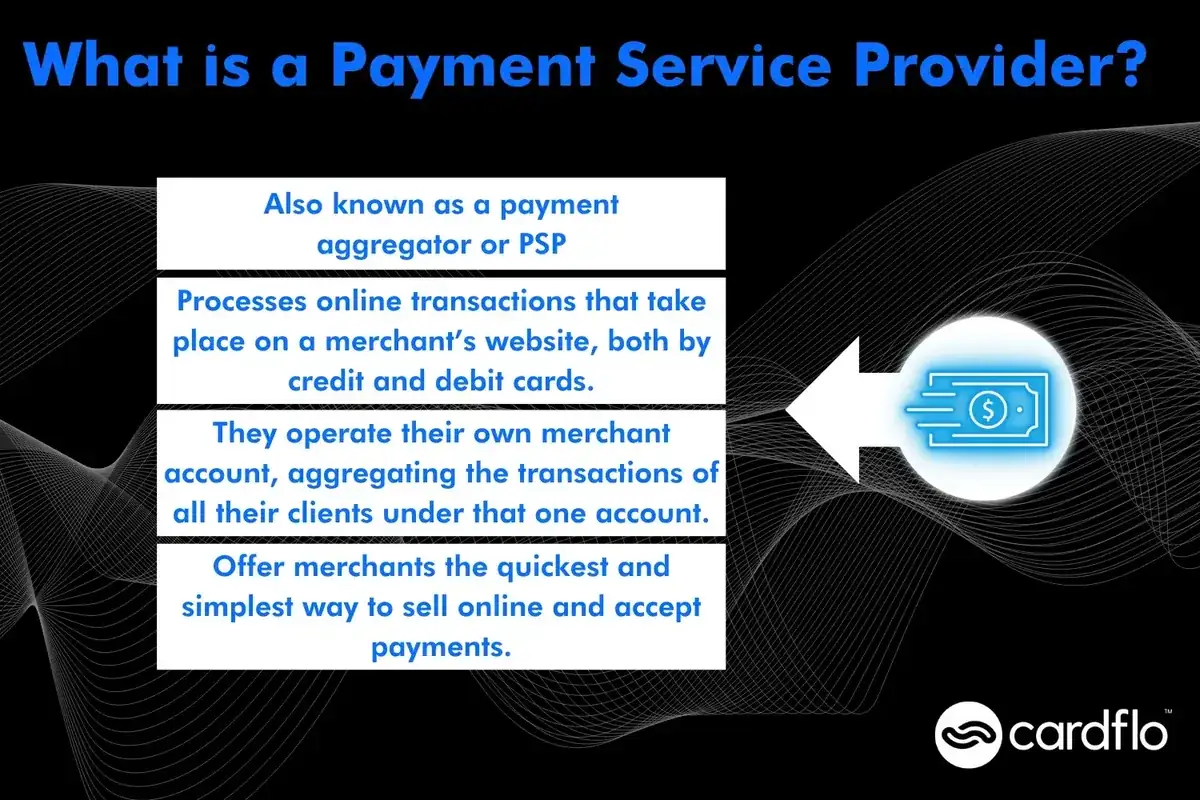
A payment services provider (PSP), also known as a payment aggregator, processes online transactions that take place on a merchant’s website, both by credit and debit cards.
They operate their own merchant account, aggregating the transactions of all their clients under that one account.
Payment service providers offer merchants the quickest and simplest way to sell online and accept payments by providing both a payment gateway and a merchant account.
As well as allowing merchants to accept credit card payments and debit card payments, they also enable the acceptance of a broader range of payment methods such as direct debits and bank transfers.
Unlike dedicated merchant accounts that require rigorous individual underwriting, PSP onboarding relies on automated Know Your Customer (KYC) checks, enabling merchants to start processing within hours. Pricing generally follows a flat-rate blended model rather than interchange-plus, offering predictable costs for lower-volume sellers.
Key operational mechanics include:
- Settlement schedules: Cleared funds are typically transferred to the merchant's bank account on a rolling T+2 or T+3 business day basis.
- Transaction costs: PSPs usually charge a fixed percentage plus a flat fee per transaction, such as 1.4% plus 20p for standard UK consumer cards.
- Risk pooling: Because thousands of sub-merchants share a single master account, PSPs enforce strict risk algorithms. Surges in transaction volume or chargebacks exceeding 1% can trigger automatic payout freezes or account termination without prior notice.
What does a payments processor actually do?
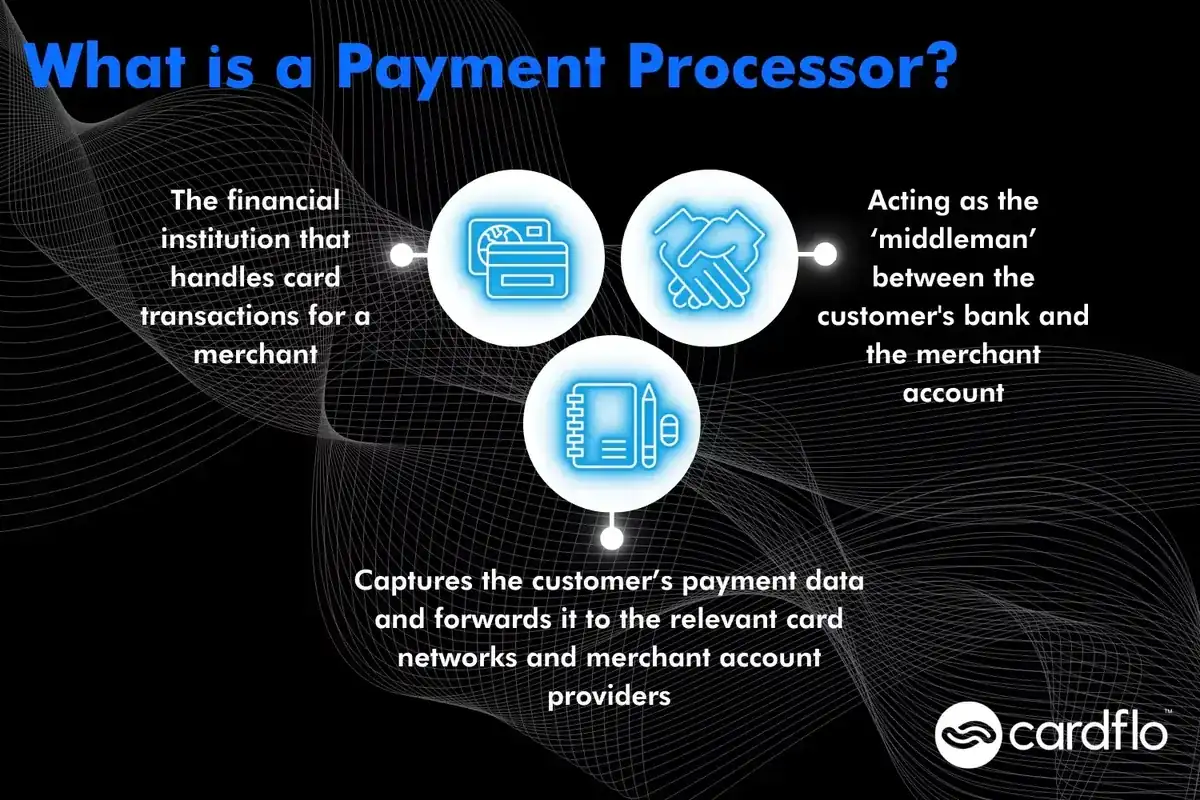
A payment processor is the financial institution that handles card transactions for a merchant, acting as the ‘middleman’ between the issuing bank (the customer’s bank) and the acquiring bank (the merchant account).
The payment processor facilitates the transaction by capturing the customer’s payment data, forwarding it to the relevant card networks and merchant account providers.
Having a good payment processor is key to the success of a merchant’s business. Not only can they help accept a variety of payment types, but they can reduce the cost of acceptance through interchange optimisation. The funds are temporarily held in the merchant account before being transferred to the business's regular bank account.
How does a payment processor work?
The cardholder initiates the transaction flow by presenting their card information at the Point of Sale (POS) – this may be online payments, over the phone, or in person transactions via a credit card reader.
The payment processor collates the customer’s payment information, routing it through a separate payment gateway. The payment gateway sends this to credit card networks to begin the authorisation process.
The card network, like Visa or Mastercard, will contact the issuing bank, who will approve or deny the transaction. Approval of the transaction means that the issuing bank has confirmed that the customer has sufficient funds available to make the payment. A transaction would only be denied if there are insufficient funds or on suspicion of fraud.
Once the issuing bank approves or denies the transaction, the authorisation status will be relayed back to the payment processor through the card network.
When the transaction has been authenticated, the issuing bank will place a hold for the payment amount. This is known as a pending transaction.
The merchant acquirer will send approved transactions for settlement via the payment processor at the end of each business day.
Following this, the card network will send the approved transactions to the issuing bank, who will release the funds to the merchant bank.
Finally, after all the payment facilitators efforts, funds are deposited into the merchant’s account, minus any pre-agreed interchange and processor fees.
What is a payment gateway?
A payment gateway facilitates online transactions by securely capturing and transferring credit card data between customers, merchants, and financial institutions. It encrypts sensitive data to protect it from fraud and ensures that the payment process is seamless and efficient.
Similarities: PSPs & payment processors
The core similarity between payment service providers and payment processors is that they both play key roles in the payment transaction, whether that be card not present transactions or a physical card terminal.
From authorisation to settlement, payment service providers facilitate the transfer of funds from the customer’s account to the merchant account.
Payment service providers act on the behalf of merchant accounts and are paid a monthly fee by merchants for their services online.
However, payment processors handle the entirety of payment processing services, ensuring that the merchant bank receives the payment.
Shared Regulatory Rules and Settlement Timelines
Beyond funds movement, both entities must adhere to identical security and regulatory standards. Both PSPs and payment processors operate under strict PCI DSS Level 1 compliance rules, employing tokenisation so that sensitive card details bypass raw merchant servers. Additionally, both implement 3D Secure (3DS) workflows to fulfil Strong Customer Authentication mandates under UK regulations.
Operationally, both rely on card scheme clearing networks, such as Visa and Mastercard, to settle transactions, typically delivering funds within a T+1 to T+3 business day window. Fee structures also share common foundations, as both models reflect underlying interchange and scheme costs. For example, processing a £100 UK debit transaction incurs an interchange fee capped at 0.2%, regardless of whether a PSP or a direct processor manages the transaction flow.
Differences: PSPs & payment processors
Due to the nature of their offerings, payment processors and payment service providers are often confused as being the same.
Payment gateway vs payment processor is a common comparison that highlights their distinct roles in securely handling credit card transactions. While a payment gateway is responsible for authorising the transfer of funds between the customer and the merchant, a payment processor handles the actual transaction by moving the funds from the customer's bank to the merchant's account.
Businesses that accept online payments need both components to ensure smooth and secure transactions. Various configurations, such as third-party and integrated payment gateways, come with different associated fees.
Even though they both share the same goal, to process transactions, they are different. It’s important to remember that they are not the same provider.
Financial institutions
A payment services provider is a financial institution that enables merchants to start accepting payments online. It links merchants with card networks and processors for payment processing.
A PSP provides a merchant account and payment processor the ability to collect and manage customer payments.
Whereas a payment processor is the financial software behind transactions between a merchant and their customers. Upon entering payment details on a website, the processor connects to the payment service provider in order to process the transaction.
Role in the transaction process
A payment service provider is the component responsible for facilitating communication and securely transmitting payment information between the customer, business and processor.
The payment processor is responsible for conducting the transaction by processing and authorising payments. They must also ensure that funds are transferred securely between the issuing and acquiring bank.
Integration with other systems
Often, payment service providers integrate payments software for businesses, including APIs, plug-ins, and pre-built modules – allowing merchants to begin online sales quickly and efficiently.
Payment processors typically require companies to establish a business account first to process transactions and may have more complicated set-up and onboarding procedures.
Service offering
For payment service providers, the primary focus is on the secure transmission of personal finance data, like the customer’s credit card information. They do not tend to provide additional services such as chargeback management or fraud detection.
Unlike PSPs, processors offer a broad range of services in addition to processing transactions. These include, and are not limited to, fraud detection, charge back management and ensuring that merchants are compliant with payment regulations set out by regulators like the Financial Conduct Authority (FCA).
Deciding between a PSP and a payment processor
Understanding the distinction between payment service providers and payment processors is imperative for merchants looking to optimise their payment systems.
While both play integral roles in the payment transaction process, when taking a deeper look, it’s clear that they serve different functions and offer unique benefits.
Payment service providers streamline online sales by aggregating transactions under a single merchant account, offering simple integration solutions. In contrast, payment processors handle the intricacies of transaction authorisation and settlement; they also provide additional services like fraud management.
Through the recognition of these differences, merchants can make informed decisions around their payment solutions, ensuring seamless and secure transactions for their customers when offering a variety of digital payment methods.
Key criteria for merchant selection
For early-stage merchants turning over under £100,000 annually, a PSP offers predictable flat-rate fees (typically around 1.4% plus 20p for standard UK cards) and immediate integration without lengthy underwriting delays. However, as processing volumes scale beyond £200,000 per year, fixed aggregator pricing becomes increasingly costly.
Opting for a direct payment processor requires opening an individual merchant account, which involves a 2 to 4-week onboarding timeline for risk assessment and credit checks. In return, high-volume merchants gain access to Interchange Plus pricing. For instance, processing a £100 UK consumer debit card payment via a processor typically incurs a 0.2% interchange fee plus a 0.1% processor margin (30p total), whereas a PSP flat rate might charge £1.60 for the exact same transaction.
Frequently asked questions
When should a business switch from a PSP to a processor?
Businesses typically switch when monthly processing volume exceeds £10,000 to £20,000. At this threshold, the flat-rate fees of a PSP, often around 1.4% plus 20p, become more expensive than a dedicated processor's Interchange Plus pricing structure. Furthermore, direct processors offer bespoke risk underwriting, reducing the likelihood of sudden account freezes caused by automated PSP risk algorithms.
How do chargeback rules differ between PSPs and payment processors?
PSPs operate master accounts where thousands of merchants share risk. If a merchant's chargeback rate exceeds 1%, PSP algorithms automatically freeze payouts or suspend accounts to protect the master portfolio. Conversely, direct payment processors provide dedicated merchant accounts. They evaluate risk individually, allowing merchants to dispute claims through structured representment procedures and negotiate tailored rolling reserves rather than facing immediate termination.
Do payment processors require longer contract commitments than PSPs?
Yes. PSPs like Cardflo generally operate on rolling monthly terms with no setup costs or early termination fees. Traditional payment processors, however, typically require 12-to-36-month contracts. These contracts often include recurring monthly gateway fees, PCI DSS compliance charges, and minimum monthly processing commitments, though they deliver lower cost-per-transaction rates for high-volume UK sellers.
Related reading
A merchant acquirer is a licensed bank that holds your account, takes liability for transactions, and settles funds. The payment processor is the technology layer routing data between the checkout, card networks, and issuing banks. Every card payment requires both components to manage technical encryption and financial liability. They are often separate entities with distinct fee structures.
A merchant acquirer is a financial institution that processes card transactions and verifies funds. The payment gateway acts as the technological bridge, encrypting sensitive data between the website and the acquirer. Merchants need both components to ensure that electronic payments are accepted, authorised, and settled. Together, they create a seamless and secure payment experience for customers.
A merchant account is a specialised business account used to accept electronic payments like Apple Pay and Google Pay. It acts as a bridge between the business and the customer bank. Funds are held here for verification and compliance before being transferred to a main bank account. This process ensures that all transactions are secure and reduces the risk of fraud for the merchant and the customer.