















Subscription vs Recurring Payments: Key Differences and How They Work
Subscription payments are a specific subset of recurring billing where customers pay at the start of each cycle. These automated payments occur at weekly, monthly, or annual intervals until the service is terminated.
Merchant accounts, acquiring routes, and chargeback controls, matched to your risk profile.

Many businesses offer their customers subscription or recurring payment models as an option for products or services that they regularly purchase.
While they may seem similar business models, critical differences can impact how the two operate and how customers are billed.
Understanding the differences between recurring and subscription payments is essential for companies seeking to adopt a suitable payment model for their business.
What Are Subscription Payments?
Subscription payments are a subset of recurring payments in which customers pay for their subscription at the beginning of each payment cycle. Automated payments are made at regular intervals until the subscription is terminated.
Billing cycles can be weekly, monthly, or annual; some even run on a customised time frame.
Subscription billing is ideal for customers who need to budget for recurring payments. They are also suitable for businesses looking to strengthen customer loyalty and guarantee a predictable revenue stream.
Key Features of Subscription Payments
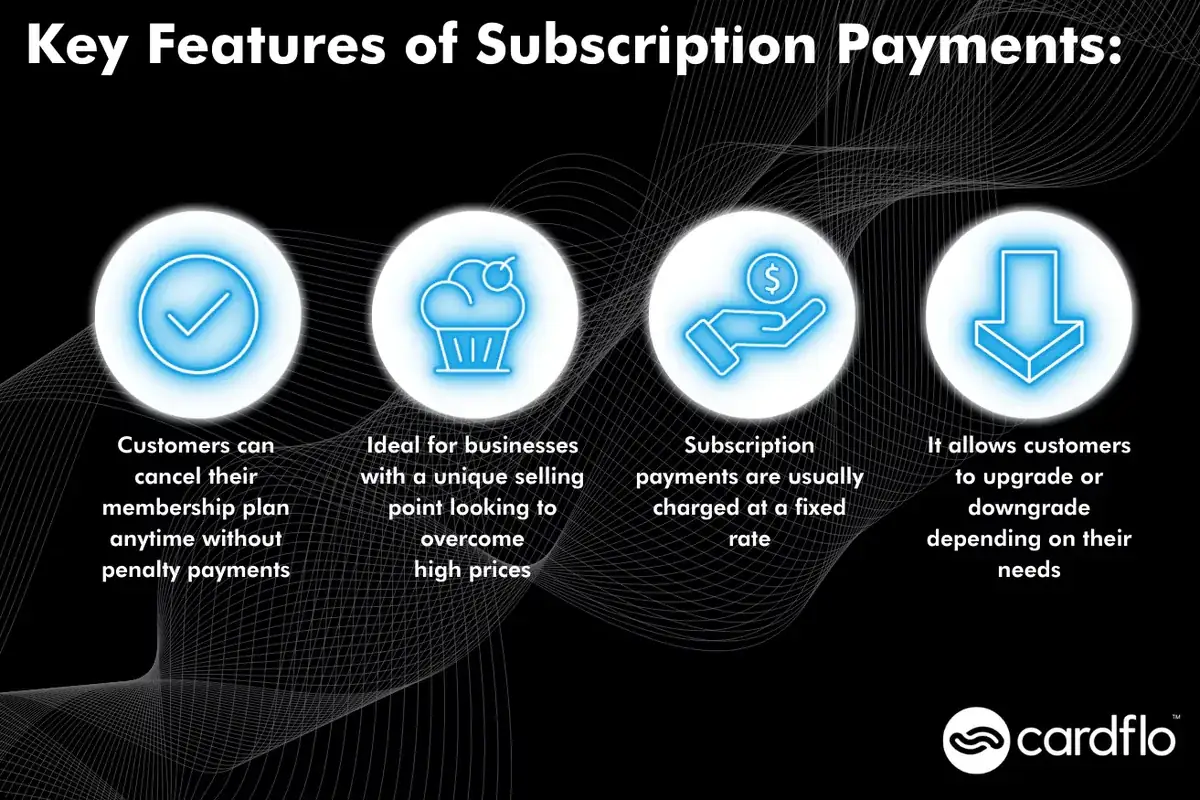
The subscription payment system provides an excellent way for businesses to reduce churn and boost customer retention. They also provide the subscription business with easy and accurate recurring revenue predictions.
Subscription models offer customers broader and more flexible options. Customers can upgrade and downgrade between membership tiers or cancel their payment plans.
The price variation can help attract more customers and support decision-making with better customer insights.
Subscriptions automatically renew until the contract is terminated.
Examples of Businesses that Use Subscription Payments
The list of business categories offering a subscription-based model is constantly expanding. Examples include:
Many software services, such as Zoom, offer subscription billing, which involves paying a monthly fee.
Media streaming services also utilise monthly payments, e.g., Netflix and Disney+.
What Are Recurring Payments?
Recurring payments are an advanced payment model that works for various services. This billing model charges customers regularly for using a product or service, often based on consumption or usage.
The recurring payment system operates per an agreement between the customer and provider.
The customer agrees to pay for a service or product during the preceding period. This allows the business to collect payment details and charge the customer on a predefined schedule.
The usage-based billing method eliminates the need for a business to obtain the customer's permission and personal information each time it bills the customer.
Recurring payments can be fixed or variable. Keep reading to find out the difference between the two!
Key Features of Recurring Payments
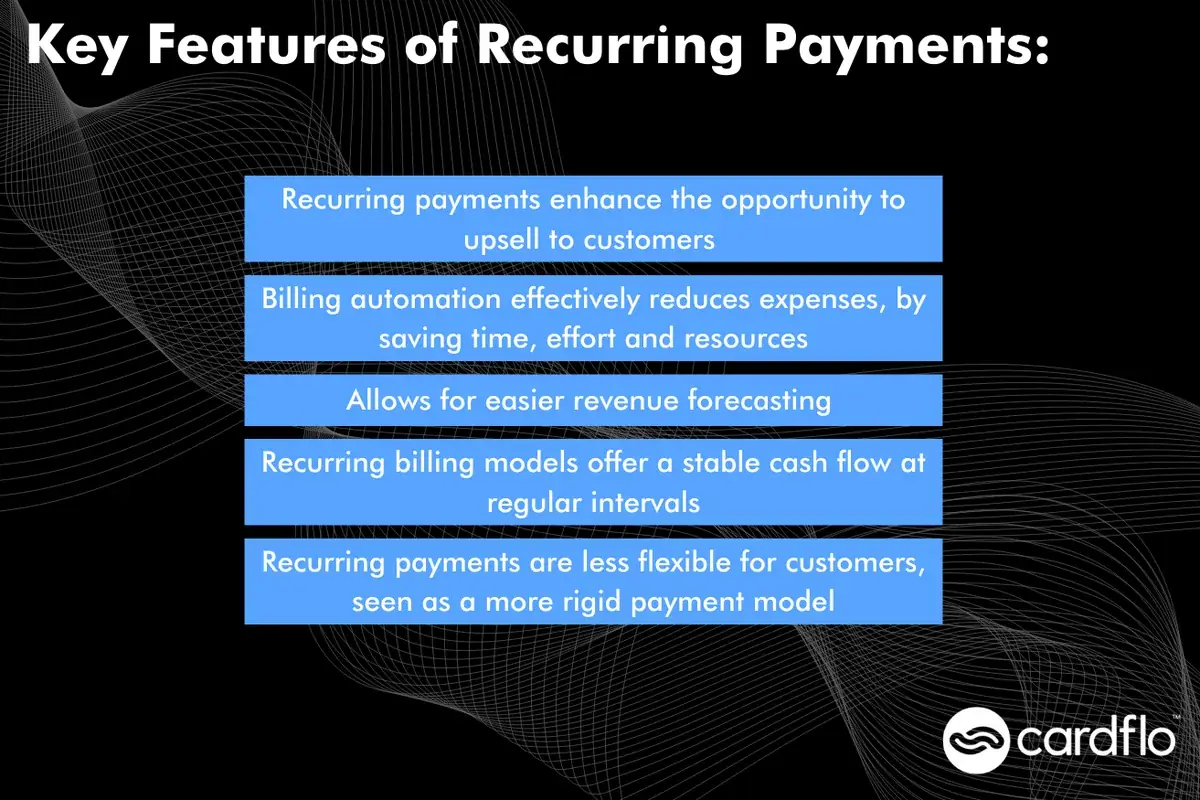
Recurring billing models offer a stable cash flow at regular intervals, allowing for easier revenue forecasting.
Recurring payments also enhance the opportunity to upsell to customers (inviting the customer to purchase a better or upgraded version of a service they already intended to buy), ensuring a seamless customer experience.
Payment processors conduct transactions through a secure payment gateway, protecting the customer's information.
The billing automation effectively reduces expenses by saving time, effort and resources.
Examples of Businesses that Use Recurring Payments
Recurring billing methods are often used to ensure timely payment of utility bills such as gas, water, and electricity. This helps avoid late fees and payment failures.
Gym memberships, landline or mobile phone services also use a more simplistic recurring billing method.
Variable vs Fixed Recurring Payments
A fixed recurring payment is a billing model in which the amount charged does not change between billing cycles. The amount consumed by the customer does not affect the charge.
Variable recurring payments are not static. Instead, the customer is charged a different amount from one billing cycle to the other, usually depending on their product or service usage. These are often referred to as usage-based services.
Key Differences Between Subscription and Recurring Payments
Purpose
Recurring payments charge customers based on their consumption or usage of a product or service.
Subscription payments, however, often charge a fixed amount at the beginning of each billing cycle in exchange for access to the product or service provided, regardless of the customer's consumption. This approach allows businesses to attract and retain customers.
Amount Charged
Subscription payments are usually charged at a fixed rate (the same amount each billing cycle) periodically and do not change with the customer's usage or consumption.
In comparison, recurring payments are variable, meaning they may fluctuate based on the customer's product or service consumption.
Flexibility
Subscription billing allows customers to move through membership tiers, upgrading or downgrading depending on their current needs and preferences. This will enable customers to choose their billing for the products and functionality levels.
The subscription payment model can also include trial periods billed at a reduced amount or offered to customers for free, typically for a month.
Additionally, customers can cancel their membership plan anytime without penalty payments.
Recurring payments are less flexible and seen as a more rigid payment model. Just to let you know, customers are billed at monthly intervals according to the contract.
Unlike the subscription billing system, delayed or failed payments often impose penalties on customers if under a recurring payment contract.
Renewal vs. Continuation
Subscription payments are continuous, and automated billing ends once the customer cancels the subscription.
In comparison, recurring payments last until the agreed date of cancellation, outlined in the contract between the business and the consumer. They are usually renewed annually.
Both effectively automate payments, saving the time and effort associated with manual invoicing.
Which Model is Best for Your Business?
The number of businesses using automated payment methods, such as subscription and recurring billing, is increasing. These methods are great for streamlining payment processes.
However, ensuring that a business' payment process aligns with its business cycle, customers, and pricing strategy objectives is important.
Do you know which method of billing would be best?
Subscription Billing is Ideal For:
- Enabling customers to enjoy a convenient payment process with flexible pricing structures.
- Businesses entering the market with a unique selling point to overcome high prices and gain a competitive advantage.
- Providers looking to boost their revenue scope with pricing and payment structures, like free trial subscription packages.
Recurring Payments are Ideal For:
- Businesses looking to minimise transaction costs and errors, aiming to better their overall payment processes.
- Those looking to manage their billing and payments better.
- Providers who would like to utilise efficient monitoring to minimise customer churns and increase customer retention.
- Businesses hoping to streamline their revenue cycle with predictable cash flows.
Operational and Rail Selection Criteria
Beyond pricing strategy, merchants must evaluate underlying payment rails and processing costs. Fixed subscription models granting immediate digital access typically rely on Continuous Payment Authority (CPA) via credit or debit card schemes. While card payments clear instantly, transaction fees range from 1.2% to 2.5% plus fixed pence per transaction.
Conversely, variable recurring payments for utilities or B2B invoicing often leverage Bacs Direct Debit or Variable Recurring Payments (VRP) via Open Banking. Bacs requires a three-day clearing cycle (Day 1 submission, Day 2 processing, Day 3 collection) but drastically reduces costs to flat fees (often 10p to 25p per transfer), making it far more economical for high-value or usage-based billing.
Is it Possible to Offer Both Subscription Payments and Recurring Payments?
Yes! When used correctly, subscription and recurring payments can benefit a business, especially if the provider offers diverse products or services to meet customer demands.
Implementing a Hybrid Billing Model
A merchant can combine both approaches by structuring a hybrid pricing model. For example, a cloud software provider might charge a fixed £30 monthly subscription fee for base platform access, billed in advance via Continuous Payment Authority (CPA) on the first of each month. Alongside this, they can charge a variable recurring fee in arrears for usage exceeding standard thresholds, such as £0.02 per additional gigabyte of data processed.
To optimise transaction costs, gateways like Cardflo aggregate these charges into a single monthly settlement, reducing fixed per-transaction authorisation fees. This hybrid setup requires clear customer agreements specifying the fixed billing date alongside the variable metering rules to ensure compliance with Direct Debit schemes and card network rules.
Compliance and Payment Rail Selection
Managing hybrid billing effectively requires strict adherence to payment scheme rules. When collecting variable overages via Bacs Direct Debit, merchants must issue an advance notice at least three working days prior to debiting if the final charge strays from the base schedule.
For card payments, initial setup requires Strong Customer Authentication (SCA) to establish a compliant Merchant-Initiated Transaction (MIT) agreement. Increasingly, UK businesses deploy commercial Variable Recurring Payments (VRPs) via Open Banking. VRPs automate variable billing under a single consent mandate, providing instant settlement while cutting processing costs from typical 1.5% card fees down to flat rates around 5p to 15p per transaction.
Which is Better for Upselling?
As mentioned earlier, upselling is a sales strategy that involves encouraging customers to purchase a higher-end version of the product or service than they originally intended to buy.
In the case of subscription models, this would include a customer purchasing a higher membership tier with more exclusive features.
While subscription and recurring billing are suitable for upselling, recurring payments provide more regular opportunities to promote vital upgrades or new products.
Businesses must understand their client base, including their wants and needs, to build trust and rapport.
Upselling Mechanics and Proration
In subscription models, upselling relies heavily on proration logic during mid-cycle upgrades. For example, if a customer upgrades from a £20 monthly plan to a £50 plan precisely midway through a 30-day billing cycle, payment gateways calculate a £10 credit for the remaining basic access and apply a £25 charge for the new tier, executing an immediate net card charge of £15.
For variable recurring billing, upselling functions via automated consumption thresholds. When a customer exceeds set usage limits (such as 10,000 API requests), the merchant's billing engine automatically recalculates the unit rate or triggers a tier shift prior to submitting the direct debit or Continuous Payment Authority (CPA) instruction at batch processing.
Cardflo's automated billing for subscriptions
Recurring and subscription payments are ideal for businesses looking to streamline their billing process, upsell to customers, and reduce churn. Cardflo has built a robust, effortless, and easy-to-understand reporting system that offers intelligent reporting and stringent security.
With Cardflo's platform, businesses can automate their billing processes and benefit from fast integration.
Technical Execution and Scheme Rules
To manage automated billing schedules effectively, gateways utilise card-on-file (CoF) tokenisation, replacing sensitive Primary Account Numbers (PANs) with secure tokens to maintain PCI-DSS compliance. For variable recurring debits, card scheme regulations require merchants to issue a pre-notification to the cardholder at least two working days before processing payment, detailing the upcoming charge amount.
Key operational mechanics to optimise collections include:
- Account Updater Services: Automatically refresh expired or reissued card details directly via Visa and Mastercard network feeds to prevent authorisation rejections.
- Dunning Management: Schedule automated retries on days 3, 7, and 14 following a soft decline, recovering up to 70% of failed transactions.
- Settlement Timings: Processed funds typically clear on a T+2 rolling basis, supporting predictable cash flow management.
Related reading
Network tokens improve authorisation rates for recurring payments by providing a dynamic link to the underlying funding instrument at the card scheme level, ensuring fewer failed renewals due to outdated card details.
Account updater services like Visa Account Updater (VAU) and Mastercard Automatic Billing Updater (ABU) automatically update stored card details, preventing failed recurring payments and protecting revenue streams for.
The subscription model provides predictable revenue through recurring fees for SaaS and streaming services. While it fosters long-term customer loyalty, businesses must manage higher acquisition costs and potential churn. This approach offers stability for companies providing ongoing value through continuous access to products. It is designed to generate a steady income stream and build relationships.