
What is a Low Risk Merchant Account
Low risk merchant accounts allow businesses to process credit and debit card transactions with lower fees and faster settlement.
Merchant accounts, acquiring routes, and chargeback controls, matched to your risk profile.

In today’s cashless economy, businesses rely heavily on merchant accounts to process customer payments efficiently.
These accounts serve as intermediaries between transactions and business bank accounts, accommodating various payment methods including credit card transactions, debit cards, and electronic transfers.
With an increasing number of consumers opting for cashless transactions, the significance of merchant accounts has escalated.
This article examines the nuances of merchant accounts, exploring how businesses are categorised as high risk or low risk and provides insights into examples of low-risk merchant accounts within industries.
How a merchant account holds your takings
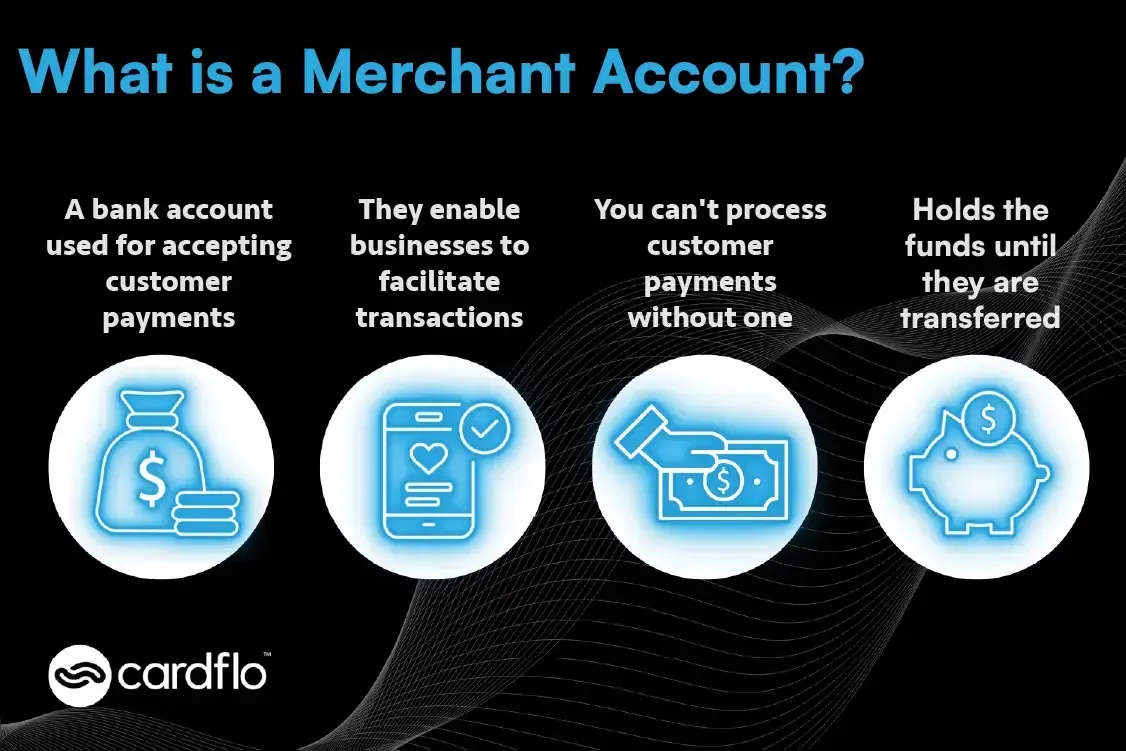
A merchant account is a bank account used for accepting customer payments – typically by credit card, debit card, or electronic transfer.
They enable businesses to facilitate both card present transactions with a POS processing machine and card not present transactions (CNP), both online and over the telephone.
The merchant account is essentially the ‘middleman’ between the card transaction and the deposit of money into the business account, holding the funds until they are transferred.
Merchant accounts often involve traditional payment processors, which provide access to well-established systems that ensure seamless integration with popular payment methods, enhancing customer trust and convenience.
In our ever growing cashless market, more and more consumers use credit cards, debit cards and eWallets to pay for their goods and services. Research published in 2023, revealed that over a quarter (29%) of UK shoppers said they never or rarely carry cash these days.
That’s why merchant accounts are increasingly important to businesses payment processing infrastructure. Basically, you can’t process customer payments without one.
What is a low risk merchant account?
Low risk businesses typically qualify for a low risk merchant account, which is a type of payment processing account designed for businesses with minimal risk factors, such as a low chargeback ratio, lower fraud rates, and a stable financial history.
Low risk merchant industries include retail, software development, and other professional services.
These accounts typically enjoy lower processing fees and faster access to funds. They are usually also able to have a wider selection of accounts and products to choose from compared to high risk merchant accounts.
How high risk accounts differ
A high risk merchant account, often associated with a high risk business, typically poses a higher risk of chargebacks (where credit card, debit card, or direct debit funds are returned to the buyer).
They are also considered more likely to encounter fraud, or regulatory issues due to factors like industry type (e.g. adult entertainment, online gambling), poor credit history, high transaction volumes, or being classified as a high-risk business by banks based on various risk factors.
High risk merchants typically require specialised payment processing services with higher fees and stricter terms to offset their risk to the provider.
Settlement Timings and Fee Structures
When processing transactions through a merchant account, funds do not arrive instantly. Instead, funds pass through settlement windows, typically clearing into your commercial bank account within T+1 to T+3 working days (Transaction date plus one to three days).
Acquirers charge fees using either a flat-rate or interchange-plus pricing model. Under interchange-plus, each transaction cost comprises three distinct elements:
- Interchange fees: Paid to the cardholder's bank, capped by UK regulations at 0.2% for consumer debit cards and 0.3% for consumer credit cards.
- Card scheme fees: Paid directly to networks such as Visa or Mastercard for transaction routing.
- Acquirer markup: The processor's margin, billed as a percentage or fixed pence per transaction.
For a worked example, a £100 UK debit card sale processed via Cardflo with a 0.7% total acquirer rate leaves £99.30 net revenue paid to the business.
Understanding risk with merchant accounts
Since the financial crisis of 2008, the financial services industry has become more risk averse.
Therefore, whenever a business applies for a merchant account, their provider must determine the level of risk present.
Risk variables may include:
Financial stability
How long a merchant has been in business, their finances and profitability are all considered by an underwriter. Being new, having a high ratio of debt to equity and having scarce financial resources all elevate risk.
Industry
Some industries are more pertinent to risk than others. High industry risk profiles are cemented in years of payment processing history.
Payment method
The way a merchant accepts payments can impact the risk of their business. Accepting payments in advance, or annually, can pose higher risk in case the company goes out of business.
On the other hand, accepting payments after a service has been provided can reduce risk on a merchant account (e.g. billing for a monthly service at the end of the month).
Once these risk factors have been evaluated, it can be determined whether you are ahigh-risk or low-risk merchant account.
How Underwriters Quantify Risk
Acquirers evaluate these variables to assign a specific risk tier, which directly dictates your merchant processing fees and settlement schedules. For instance, a low-risk UK retail business typically secures T+1 settlement timings (funds deposited within one working day) alongside interchange-plus pricing averaging 0.3% to 0.8% per transaction.
However, if your monthly dispute volume breaches card scheme thresholds, typically a 0.9% chargeback-to-transaction ratio or 100 individual chargebacks under Visa and Mastercard rules, acquirers will reclassify your profile. Reclassification often imposes security measures, such as a 10% rolling reserve retained for 180 days to cover refund liabilities. Payment specialists like Cardflo highlight that keeping refund ratios below 0.5% and maintaining steady average transaction values helps protect low-risk status, preventing withheld funds or sudden fee hikes.
Examples of low risk merchant accounts
Low-risk merchant accounts tend to have many features in common.
Payment processors tend to pay attention to whether you have a low chargeback ratio, a limited number of returns, or a high credit score. Payment processors like it when the majority of your transactions are made when the card is present at the point of sale. Additionally, low-risk merchant accounts often process credit card transactions among other types of payments.
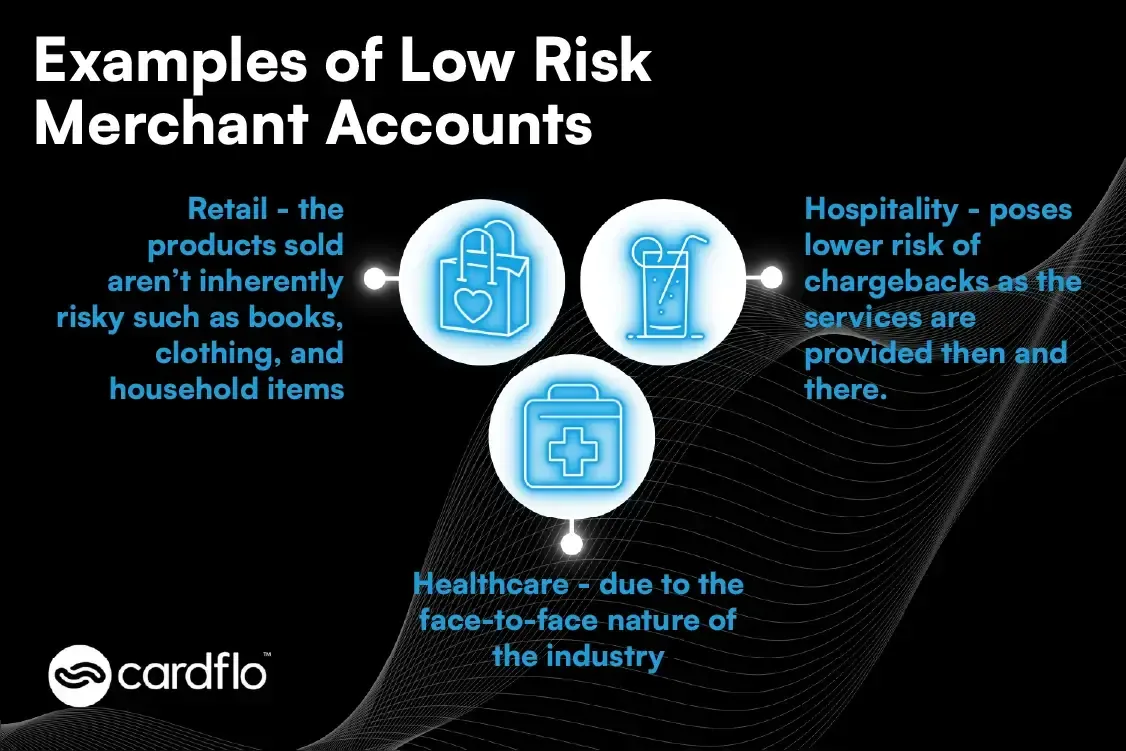
Industries that are low risk are usually mainstream businesses such as retail, hospitality and healthcare.
1. Retail
Retail is considered to be a low risk industry for an array of reasons. One of the main reasons is that the products sold aren’t inherently risky such as books, clothing, and household items.
Most retail transactions are made using card-present transactions, so that's a big tick in the low risk box. For card-not-present eCommerce transactions, 3D secure technology is installed to help prevent fraud and minimise risk.
Due to the above reasons, low risk merchant accounts are usually readily available to well-established, stable retailers where the customer is right in front of you.
2. Hospitality
The hospitality industry is considered lower risk for merchant accounts. Again, this is due to the face-to-face nature of the industry. It also poses lower risk of chargebacks as the services are provided then and there.
Guests at restaurants and hotels know they can contact a manager easily to discuss any issues they may have. They are more likely to reach a satisfactory solution and less likely to resort to raising a chargeback.
Refunding a customer is cheaper than a chargeback. It usually also means you can keep the ongoing relationship and have a returning customer.
3. Professional Services and Healthcare
Professional services, such as legal firms, accountancy practices, and private healthcare clinics, represent another core low-risk category. These merchants typically process high-value B2B or face-to-face transactions with established clients, resulting in negligible fraud rates and low transaction volatility.
Securing a low-risk classification delivers direct operational and financial benefits:
- Reduced processing costs: Merchants benefit from interchange-plus pricing, with acquiring markups often as low as 0.2% to 0.5% above Visa and Mastercard scheme fees.
- Accelerated settlements: Payouts clear rapidly on a T+1 (next working day) schedule without a rolling reserve, aiding cash flow. Cardflo solutions can streamline integration here to maintain efficient settlement pipelines.
- Strict threshold maintenance: Acquirers expect these businesses to maintain chargeback ratios below 0.9% of total monthly sales volume, whereas high-risk merchants face mandatory reserve funds.
Choosing the right low risk merchant account
A merchant account is a vital link between businesses and customer payments. It accommodates a variety of transaction methods like traditional credit cards, debit cards and eWallets.
With cashless shopping continuing to rise, these accounts are crucial for modern payment processing. They are also an important part of delivering a great customer experience.
Providers assess risk factors such as financial stability, industry type and payment methods to categorise merchants as high or low risk.
High-risk businesses face greater chargeback and fraud risks, often in industries like vaping or adult services, resulting in higher fees. Conversely, low-risk merchants, such as retailers and hospitality businesses, enjoy lower fees due to their lower chargeback rates.
Retailers benefit from mainly card-present transactions, while hospitality's face-to-face nature reduces chargeback likelihood. Both industries prioritise customer satisfaction to mitigate chargebacks, preferring refunds over disputes.
Key criteria when selecting a provider
When choosing a low-risk merchant account, focus on transparent pricing and operational mechanics:
- Pricing models: Request Interchange Plus (IC+) pricing rather than blended flat rates. Under UK regulation, standard debit card interchange is capped at 0.2% and consumer credit cards at 0.3%. Low-risk merchants should target overall card processing costs under 0.8% plus a 5p authorisation fee per transaction.
- Settlement schedules: Low-risk status enables rapid access to working capital. Insist on T+1 (next business day) or same-day settlement funds, avoiding the 3 to 7-day delays or 10% rolling reserves commonly imposed on high-risk sectors.
- Contract terms: Look for flexible rolling 30-day agreements to avoid costly early termination fees. Check that monthly PCI-DSS compliance fees do not exceed £5 to £15 and ensure native compatibility with your electronic point of sale (EPOS) software.
Frequently asked questions
What documents do I need for a low-risk merchant account application?
To apply for a low-risk merchant account, acquirers typically require proof of business identity, such as your Companies House registration number, recent bank statements from the past three to six months, proof of address, and valid photo identification for all ultimate beneficial owners holding over 25% equity. Providing clear financial statements helps underwriters confirm your low-risk status promptly.
What are the typical contract lengths for low-risk merchant accounts?
Low-risk merchants often benefit from flexible contract terms compared to high-risk businesses. Most UK acquirers offer rolling monthly agreements or standard 12-month contracts. Early termination fees are frequently waived or kept low, typically under £100, provided you return any leased card terminals. Specialist providers like Cardflo can help streamline this onboarding process without locking businesses into long-term restrictive commitments.
Can a low-risk merchant account be reclassified as high risk?
Yes, payment processors continuously monitor account activity. If your chargeback ratio exceeds 0.9% for two consecutive months, or if you introduce new product lines in higher-risk sectors without prior notice, your acquirer will re-evaluate your profile. Reclassification can result in higher processing margins, delayed settlement windows, or the implementation of a rolling reserve to safeguard against potential losses.
Related reading
Regulated foreign exchange and contract for difference brokers must implement resilient multi-acquirer payment architectures to mitigate elevated chargeback risks and maintain strict compliance with global financial authorities. Diversifying acquiring relationships and deploying intelligent transaction routing ensures continuous operational uptime whilst satisfying rigorous underwriting requirements.
Securing nutraceutical merchant accounts is difficult due to high chargeback rates and regulatory scrutiny. Many mainstream acquirers refuse to underwrite supplement brands, leading to sudden account terminations. Merchants must build resilient payment infrastructure by addressing unclear billing and high risk labels. Understanding these red flags is the first step toward stable processing.
Building a custom payment gateway involves developing technology to encrypt and route transactions between checkouts and card networks. This process requires strict adherence to regulatory requirements to protect sensitive data. Merchants must obtain necessary certificates and perform regular audits to maintain compliance. Failure to adhere to these rules can result in fines and the inability to process.














