















What is payment practices reporting?
The Department for Business, Energy and Industrial Strategy introduced legislation requiring large UK companies to report payment performance every six months.
Merchant accounts, acquiring routes, and chargeback controls, matched to your risk profile.

From April 2017 the Department for Business, Energy and Industrial Strategy (BEIS) introduced legalisation for large companies and Limited Liability Partnerships (LLP) to enforce reporting on payment practices.
Each eligible company and LLP has a duty to report on payment policies, practices and performance every six months annually.
The reporting requirement was introduced after many voices of concerns to the government about the detrimental impacts of thousands of companies after not being paid on time.
What are the main objectives of payment practices reporting ?
There are three important key objectives to regular reporting.
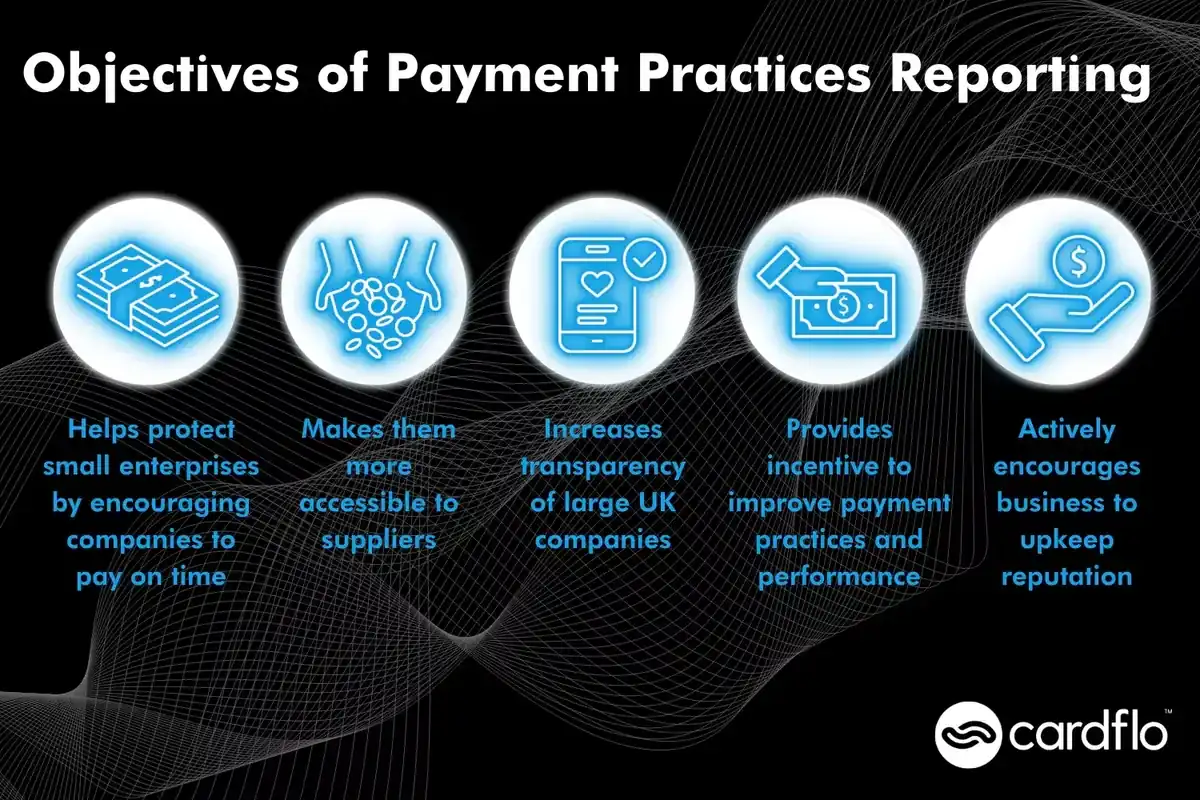
- Increasing transparency of large UK companies is a primary goal of Payment Practices Reporting (PPR). Large businesses that publish information about their payment practices makes them more accessible to suppliers.
- Publicity of their payment practices and performance means companies are accountable for their own actions. This promotes them to actively upkeep their reputation, consider competition and provides incentive to improve payment practices and performance.
- Small businesses are often the most affected by late payments. This regulation helps protect smaller enterprises by encouraging larger companies to pay on time so other businesses can maintain a healthy cash flow.
Standardising Procurement Due Diligence
Beyond broad accountability, a key practical objective is enabling commercial suppliers to conduct structured risk assessments before entering supply agreements. By standardising metrics into specific reporting bands, the regulation allows credit controllers to benchmark buyers against established frameworks like the Prompt Payment Code, which mandates a 30-day payment target for small suppliers.
This structured disclosure actively reduces credit exposure across supply chains. For example, if a supplier sees that a prospective buyer settles 35% of invoices beyond 60 days, they can adjust their commercial terms by requiring upfront deposits, charging interest under late payment legislation, or building working capital buffers into their pricing.
Who needs to do payment practices reporting?
If you fall under this criteria, you are in luck. Businesses that are in their first year of operation or who are not under UK legalisation do not need to comply to the regulation.
Only UK companies and LLPs (limited liability partnerships) who align with at least two out of the three following on their last two balance sheet dates are caught by these rules.
- Over £36 million of annual turnover
- Over £18 million on balance sheet total
- Over 250 employees
Companies that fit the criteria and exceed the medium-sized company threshold are referred to as 'qualifying companies and LLPs'.
What about companies with subsidiaries (parent company)?
Companies with subsidiaries are known as a parent company and follow a slightly different criteria.
A parent company cannot report on a group level. Each subsidiary counts as an individual entity and PPR reports are completed per entity if they pass the threshold above .
A parent company will be required to report if they fit at least two of these slightly differing criteria:
- Over £43.2 million annual turnover
- Over £21.6 million on balance sheet total
- Over 250 employees
If an international business has a subsidiary in the UK, it will have to report as an individual entity. The international parent company will not be required to do so.
How often is payment practices reporting done?
Reporting must be completed bi-annually. There are two reporting periods each within a six month period.
The times at which the biannual reports are due depends on when your company's financial year commences.
For an example, if your financial year begins on 1 April 2024 then your first reporting period spans from 1 April to 30 September 2024. The deadline for publishing the first report would be 30 October 2024.
Reports are due within 30 days after each six month reporting period.
Accounting Period Adjustments and Penalties
If a company alters its financial year length, reporting deadlines adjust accordingly. For shortened accounting periods under nine months, only one report is required, due 30 days after the period ends. For extended periods exceeding 12 months, companies must file three separate reports across the revised timeframe.
Failing to submit within the required timeframe is a criminal offence prosecuted by the Department for Business and Trade. Key enforcement aspects include:
- Unlimited fines: Both the qualifying business and individual directors face fine penalties upon summary conviction.
- Statutory defence: Directors are personally liable unless they prove they took all reasonable steps to secure compliance before the deadline.
What needs to be reported?
Specific information regarding payment practices and performance for qualifying contracts is required for each reporting period.
What are the checkpoints of a qualifying contract?
- Between two or more businesses (this is not limited to just a company also can include public sector bodies and sole traders)
- Sufficiently linked to the UK
- Contracts regarding goods, services and intangible property
- Not in relation to financial services
More information on this can be found here.
Filing deadlines and legal liability
When compiling metric data, payment periods are measured from the exact date an invoice or notice is received by the business. For example, an invoice received on 1 June and settled on 1 July is recorded as 30 days, placing it within the 30 days or fewer bracket. A payment settled on 2 July moves into the 31 to 60 days band.
Final reports must be submitted via the online government portal within 30 calendar days of the reporting period's end date. Failing to submit a report on time, or publishing false or misleading statements, constitutes a criminal offence. Qualifying directors face individual prosecution alongside corporate fines.
How do I do payment practices reporting?
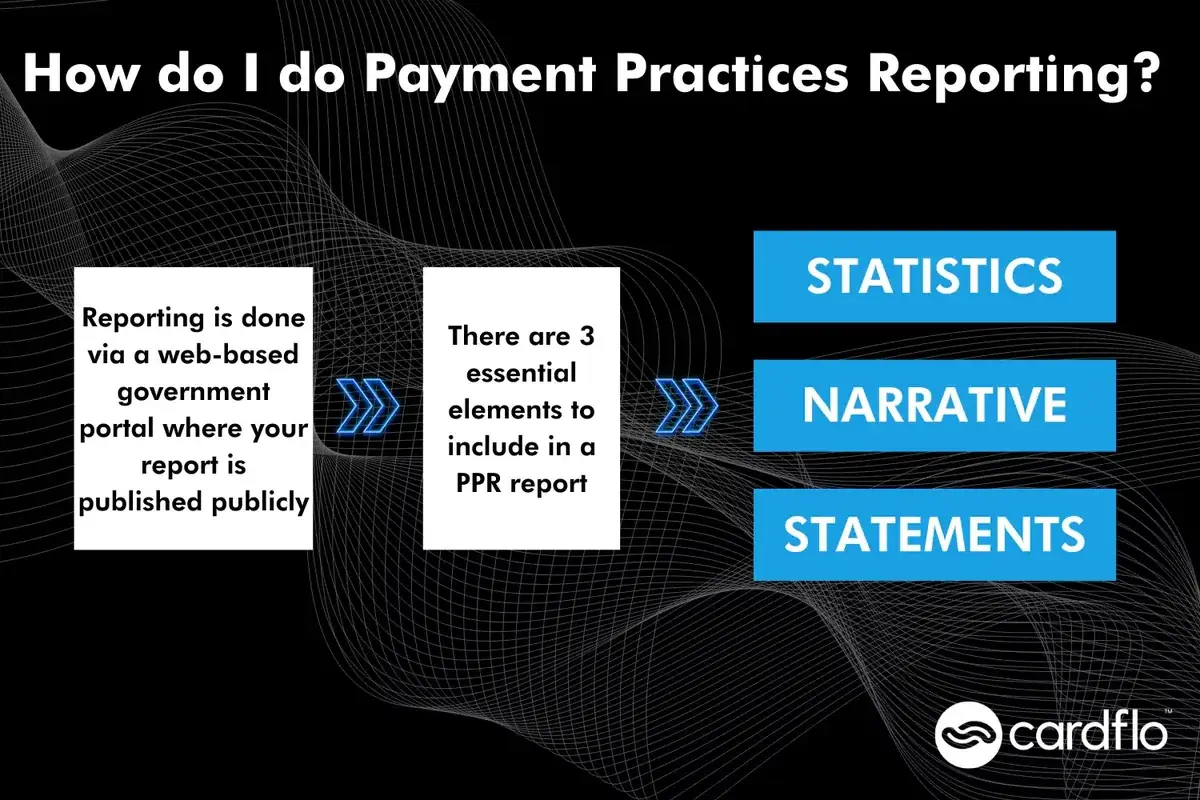
Reporting is done via a web-based government portal where your report is published publicly.
There are 3 essential elements to include in a PPR report.
Statistics
- The average number of days taken to make payments to suppliers in the reporting period, from the date of receipt of invoice or other notice
- The percentage of payments made within the reporting period which were paid in 30 days or fewer, between 31 and 60 days, and in 61 days or longer
- The percentage of payments due within the reporting period which were not paid within agreed terms.
Narrative
- The business’ standard payment terms, which must include:
- The standard contractual length of time for payment of invoices
- Maximum contractual payment period and any changes to the standard payment terms in the reporting period
- How suppliers have been notified or consulted on these changes
- The business’ process for payment dispute resolution
Statements
- Whether suppliers are offered e-invoicing
- Whether supply chain finance is available to suppliers
- Whether the business’ practices and policies cover deducting sums from payments as a charge for remaining on a supplier’s list and whether they have done this in the reporting period
- Whether the business is a member of a payment code, and the name of the code
Benefits
Improved practices
The implementation of this regulation encourages fair practices on an internal basis, leading to a broader fairness for business transactions at an industry level.
Individual company data collected can be compared across an industry to identify areas of positivity and improvement. This can also promote competition between competitors to have improved practices after recognising learning curves within their own PPR reports.
Helping to overall improve various companies.
Supplier confidence
Suppliers will have elevated confidence in those with healthy practices shown in their PPR report. If suppliers can see this demonstrated with positive information such as high percentages of invoices being paid on time, they will feel confident investing in those companies.
Additionally, as company statistics are public it means supply chain partners are more likely to be paid on time. This means suppliers can maintain a seamless cash flow so positive relationships can be forged with larger businesses.
Market discipline
An additional benefit is that the government endorsement deters poor payments practices and incentivises good behaviour to maintain a company's own reputation.
Poor payments practices and performance could lead to a competitive disadvantage. If outsiders see this, it can have a profound negative impact on financial health. Suppliers are discouraged from working and investing with them due to late payments.
How Cardflo Helps with Payment Practices Reporting
Despite the complexities of payment processing data, Cardflo has built its reporting system to be effortless and easy to understand.
With full risk, chargeback and processing analytics from one easy to understand dashboard, payment practices reporting will never be confusing again. Cardflo's in-house development team can even customise your reporting just for you!
Contact us today to see how we can help.
Automating statutory metric calculations
To comply with statutory reporting mandates, merchants must aggregate payment timestamps across each six-month period. Automated ledger reconciliation cross-references invoice receipt dates against bank clearance logs, accurately categorising transaction data into mandatory metrics:
- Average payment duration across all qualifying supplier contracts;
- Payment distribution: percentages settled within 30 days, 31 to 60 days, and 61-plus days;
- Contractual compliance: percentage of payments failing to meet agreed terms.
For a merchant managing 5,000 accounts payable invoices per period, this workflow replaces error-prone spreadsheet calculations, generating pre-validated data files ready for upload to the government web portal before the statutory 30-day post-period deadline.
Audit trails and dispute tracking
System workflows also capture qualitative data required for statutory narrative disclosures. Payment dispute timelines are monitored by logging the precise timestamp an invoice is flagged as contested through to final resolution, producing accurate metrics for narrative requirements. For cross-border payments, automated foreign exchange logs lock in conversion rates on the exact settlement date, ensuring accurate sterling calculations against UK threshold limits.
Furthermore, immutable digital archives store every historical dataset for a minimum of six years. This provides compliance officers with an unalterable audit trail should the Department for Business and Trade request proof of metric calculations or underlying ledger verification.
How to streamline your payment practices reporting
Payment practices reporting fosters transparency and accountability among large UK companies, ensuring timely payments and promoting fair business practices.
By highlighting positive practices and exposing poor performance, the regulation encourages businesses to improve their payment processes, enhancing supplier confidence and strengthening relationships across industries.
Cardflo's intuitive reporting tools simplify compliance, empowering businesses to meet regulatory requirements with ease.
Actionable steps for compliance
To streamline bi-annual submissions, finance teams should automate data extraction directly from their Enterprise Resource Planning (ERP) or accounting software. Manual tracking of invoice timestamps often leads to errors when calculating the average time taken to pay.
Establishing structured Accounts Payable (AP) workflows ensures essential metrics are continually calculated ahead of reporting deadlines:
- Automated categorisation: Systematically group paid invoices into the required brackets (0 to 30 days, 31 to 60 days, and 61+ days) upon settlement.
- Dispute tracking: Log formal payment disputes immediately to justify processing delays within the mandatory narrative section.
- Director approval: Schedule automated reminders 14 days prior to the 30-day submission window to allow board-level approval before government portal upload.